Tuesday, May 27, 2008

Planning - Shockwave presentations + Theoretical position

Shockwave presentations

Alright. I've made two shockwave presentations for showing our questions one after the other. I know we all chose
"He who fails to plan, plans to fail" but I've done a backup presentation of "Planning bridges the gap between where we are and where we intend to go". I'll show you guys both presentations before class today and you can choose. Additionally, below I am writing little sentences to support either one of our theoretical positions in the presentation today.

Planning - Theoretical position
  • Theoretical position 1 - "He who fails to plan, plans to fail".
Okay based on the e-mail messages, our theoretical position is "He who fails to plan, plans to fail".

Rachel since you're starting first you'll just have to say that line to introduce our presentation.

The last person to present which might be me or whoever does says their educational plan last needs to say this to end the presentation:

"In conclusion, creating a plan does not always guarantee success but without one almost definitely ensures failure. "


  • Backup theoretical position 2 - "Planning bridges the gap between where we are and where we intend to go"


1. Again, Rachel starts first and simply states our theoretical position.

2. Again, the last person to present will end with this:

"In conclusion, planning provides us with a clearer forecast of the future and helps to guide us to reach our intended goals."


We'll discuss more later. Cya everyone. Good luck.

Planning - My speech

Here is a copy of my speech/answer for my question. Please post yours on your blog guys so that we all have a good idea what we're all saying.

Individually identify your educational plan, both in terms of this course, and the degree in general?

“My educational plan in terms of the course is to enhance my knowledge and thinking of the nine main elements relating to collaboration we are all studying during this semester. I want to understand what the importance of these terms to me as a student and how I can apply this to work I do in the future. Additionally, I aim to develop my teamwork, oral and written skills. I aim to do this by consistently doing comprehensive research on each term every week to produce a defined blog post that represents my understanding and depth of knowledge of the term. Also I aim to augment this with daily or weekly practice in UT3 to develop my digital modeling skills. In terms of the degree, I ultimately aspire to study courses that interest me and be beneficial to my future career. It is imperative that I have a dedicated and organized attitude towards my university work to ensure a successful outcome. Also I owe it to my wonderful parents =D”

Approximately 50 seconds duration.

Good luck with everything guys. Cya all tomorrow.

Terrain & Video progress

Video
I've just completed the video for planning and will be uploading it onto youtube and then the wiki within the next hour. Personally I think its boring haha but it states what planning does, how we've shown it and our progress in fabrication.

Terrain
I have done the Terrain to a state I believe acceptable to show in our presentation tomorrow. It contains the general contours and basic terrain ground materials, surrounding buildings, indicative areas of foliage and appropriate skydome. There is definitely still more work to do. I need to add materials to the surrounding buildings, make a good road, more accurate representation of foliage, adding street signs, electricity lines, etc, fix the ocean and lighting. At the moment, the water I create isn't rendering/building properly. It's always black. I've followed the tutorials but its still not working. I'll probably just start doing the water from scratch. Anyways, please read your e-mails guys! It's important for tomorrow. Below are some progress images of the terrain.


Monday, May 26, 2008

Week 10 Task

Planning

Planning is the “act of formulating a program for a definite course of action” [1] Before undertaking any sort of project or task, a plan must be developed. “Preparation of a comprehensive plan will not guarantee success, but lack of a sound plan will, almost certainly, ensures failure.” [2] The plan should be a “realistic view of the expectations” [3]. It is the key to growth, helping too forecast the future to some extent and bridge the gap between where we stand and where we intend to go. There are numerous critical elements that a plan must contain in order to be effective. The plan should be set by a person having authority and define a clear and realistic goal. It should be easily measurable in qualitative and quantitative terms in order to provide a benchmark upon which actual performance can be measured and assessed. Additionally, the plan should outline specific strategies to implement throughout the project so that there is a clear definition of action towards achieving short and long term goals. However, a plan is never perfect. It cannot exactly predict the future but when done correctly, it can provide the best possible direction in successfully completing the project or goal.


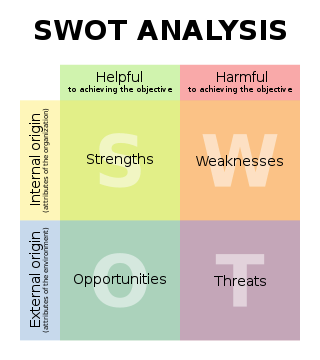
One of the most effective tools in strategic planning is the SWOT analysis. “It involves specifying the objective of the business venture or project and identifying the internal and external factors that are favorable and unfavorable to achieving that objective” [4]

By taking a comprehensive review of both the internal and external environment of a business or any collaborative work, understanding where we stand and factors that can be beneficial or detrimental to achieving the project or goal are clearly defined. There are a multitude of types of planning such as the business plan, statutory planning and strategic planning but all contain the same concepts or critical elements as aforementioned. The process of planning is primary to the success of any project being undertaken. Beginning a project without a clear and comprehensive plan will ultimately waste time and resources. The effectiveness of ones methods are weakened without the guidance of a plan. In short, “He who fails to plan, plans to fail.” [5]

References

1. http://wordnet.princeton.edu/perl/webwn?s=planning Accessed: May 26, 2008.

2. http://en.wikipedia.org/wiki/Planning#Planning_basics Accessed: May 26, 2008.

3. http://en.wikipedia.org/wiki/Planning#Planning_basics Accessed: May 26, 2008.

4. http://en.wikipedia.org/wiki/SWOT_analysis
Accessed: May 26, 2008.
5. http://thinkexist.com/quotation/he_who_fails_to_plan-plans_to/169985.html Accessed: May 26, 2008.
Image - http://upload.wikimedia.org/wikipedia/commons/thumb/0/0b/SWOT_en.svg/320px-SWOT_en.svg.png Accessed: May 26, 2008.

Haughey, D 2008, Project Planning A Step by Step Guide, Accessed: May 26, 2008. <http://www.projectsmart.co.uk/project-planning-step-by-step.html>

Problems

Apart from being sick, I am having emotional problems right now. It's really personal so I don't want to say anything. It's affecting my uni work and I am doing what I can. I am sorry my blog hasn't been done yet. I am trying to do it now.

Tuesday, May 20, 2008

Terrain progress

Sadly, all I can say is progress is slow. Primarily because I am busy with so many other things. But I've decided to post a plan.

Using Unreal on my computer is really a pain. It's so slow, I best set aside a date to use the computers at university so I can work better.

The next weeks plan

May
Wednesday 21st - Help from group. For example, more clarification on details of the site.
Thursday 22nd - Plan out terrain.
Friday 23rd - Spend a day at Uni. Aim: General contours done. Add in the road.
Saturday 24th - Work on Planning presentation. Other uni work.
Sunday 25th - Work on Planning presentation. Other uni work.
Monday 25th - Spend another day at Uni. Aim: Start to add meshes. Surrounding buildings etc
Tuesday 26th - Work on Planning presentation. Other uni work.
...

Essentially, what I want to have done by next week before our groups final presentation is the terrain with decently appropriate and accurate contours with surrounding landscaping done so we've got something good to show. I'll do my best. Just having some problems at the moment. Cya guys tomorrow.

Week 9 Task

Remuneration

Remuneration “is pay or salary, typically monetary payment for services rendered, as in an employment.”[1] It is decided by numerous factors such as skills, experience and/or uniqueness of work. But is having monetary remuneration enough? Retention of individuals working together as a group is critical. All those involved inherently have “a personal desire to feel needed, valued and appreciated in their role”[2] Acknowledging and recognizing each persons personal contribution as a priority to the group and project will ultimately result in a more productive collaborative process. Group members will be satisfied and more motivated to work. But how do we achieve effective and ongoing retention? There are a multitude of ways to retain the loyalty and motivation of individuals, group members or employees. An obvious example is remuneration. Conclusively, money can be said to be the primary motivator. Whilst the majority of us value money, sacrifices need to be made in order to attain it. For example, the amount of time we spend to earn it, the amount of energy spent and loss of opportunities like spending time with family. Nowadays, the balance between work and life is difficult to coordinate and simply receiving money as recognition of work isn’t always enough.

Other forms of recognition in terms of non-monetary remuneration can be implemented. Examples of non-monetary remuneration include simply saying thank you to a colleague requires no money and is highly valued by the individual. Being courteous and grateful to your employees or fellow colleagues for their contribution is at times much more effective in retention as it provides them with intangible benefits of increased self-esteem and added self-value as opposed to the tangible benefits attained through expected monetary remuneration. Another example of non-monetary remuneration is public recognition. Thanking a particular individual in front of fellow colleagues for their outstanding achievement/contributions provides them with a sense of pride and self-worth, hence, more intangible benefits. Symbolic rewards are another type of non-monetary remuneration. These rewards can be items such as a certificate or 'trophy' acknowledging/recognising the achievements of an individual. For example, in the workforce, awarding an employee the title “Employee of the Month” for their work is another great tool for retention.
Additionally, another example of non-monetary remuneration is inexpensive awards. Giving employees or individuals items such as a bottle of wine, free movie tickets or box of chocolates for their contributions can be a another great motivator and a meaningful demonstration of thanks which ultimately develops a better relationship. Expensive awards can also be introduced. For example, giving an overseas trip to a performing individual, group or team is a highly effective and popular form of recognition, not only because of the magnitude of the reward but the opportunity it provides them with time to reflect and bond with fellow colleagues outside a professional/working environment. In the long term, this could prove beneficial as it allows for a group to develop a stronger relationship that will ultimately help to generate a more effective collaborative group for future projects.

With all of this in consideration, nobody within a group or team should be singled out. Each person should be acknowledged for their work, whether it is small or big, in order to promote equality and retain the loyalty of all involved in collaboration. In conclusion, remuneration is an essential element in the process of collaboration as it provides both tangible and intangible benefits to all involved. Determination of remuneration should always be done fairly in order to equally recognize the work and effort of an individual.

"Cash-based remuneration is expected, it is contractual and it represents a person's value in the marketplace. Non-monetary recognition has a feel-good factor and goes a long way towards fulfilling the unwritten but highly valued psychological contract." - Sharon Searle. [3]


References
1. http://en.wikipedia.org/wiki/Remuneration
Accessed May 19, 2008.
2. Giles, T 2004, REMUNERATION; Non-Monetary Rewards - As part of the remuneration. Accessed May 19, 2008. <http://findarticles.com/p/articles/mi_qn5305/is_20041004/ai_n24914613>
3.
Giles, T 2004, REMUNERATION; Non-Monetary Rewards - As part of the remuneration. Accessed May 19, 2008. <http://findarticles.com/p/articles/mi_qn5305/is_20041004/ai_n24914613>
Image: http://www.freeprintablecertificates.net/samples-paid/employee_of_the_month_2.png Accessed: May 19, 2008.